Greek Yogurt Cloud Bread
Light, airy cloud bread made with whipped egg whites and Greek yogurt instead of cream cheese, for sandwiches and burgers. About <1 g of carbohydrate and 5 g of protein per round.
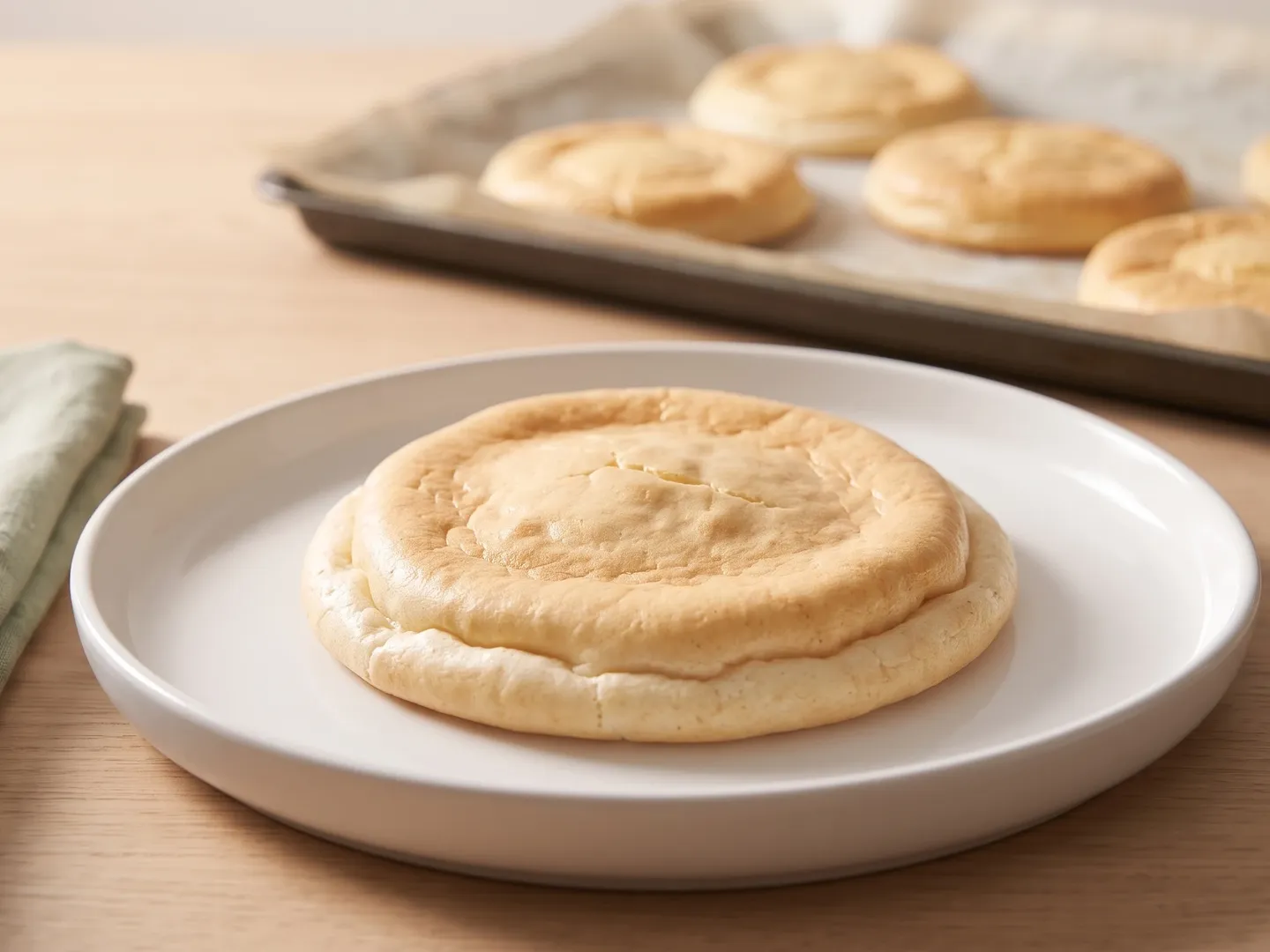
One serving
One serving is 1 round, about 4 inches (makes 6). Prep 30 min · Cook 30 min · Rest or chill 10 min.

Steps
Heat the oven to 300°F (150°C), line a dark sheet pan with parchment and let the oven preheat for 15 minutes.
Separate the eggs while cold, one at a time over a cup so no yolk gets into the whites, and tip each white into a very clean glass bowl. Let the whites stand 20 minutes while the oven heats. Whisk the yolks with the Greek yogurt and salt in a small bowl until completely smooth.
Beat the whites with the cream of tartar using an electric mixer until stiff peaks form, about 3 minutes: the peaks stand straight up when you lift the beaters. Stop there; over-beaten whites turn grainy and separate.
Stir about a third of the whites into the yolk mixture to lighten it. Then gently fold this mixture into the remaining whites with a spatula until no yellow streaks remain, keeping as much air as possible.

AI-generated illustrative image. Right away, spoon 6 equal mounds (about ⅔ cup each) onto the pan, at least 2 inches apart, and smooth them to about 4 inches (10 cm) wide and ¾ inch (2 cm) tall.
Bake on the middle rack until the tops are golden and dry to the touch and the centers no longer look moist, about 30 minutes; a thermometer in the center should read at least 160°F (71°C). On a dark pan, check that the bottoms aren’t getting dark after 25 minutes.
Let them cool on the pan for 5 minutes, then lift them with a thin spatula onto a wire rack. They sink a little as they cool. Cool completely, about 1 hour, before storing.
On the plate
Stands in for bread: one round has about <1 g of carbohydrate and 5 g of protein, so a sandwich on two rounds adds very little carbohydrate.
Nutrition
| Nutrient | Per serving (1/6 of recipe) |
|---|---|
| Calories (kcal) | 54 |
| Total carbohydrate | <1 g |
| Dietary fiber | <1 g |
| Total sugars | <1 g |
| Protein | 5 g |
| Total fat | 3 g |
| Saturated fat | 1 g |
| Sodium | 70 mg |
Total carbohydrate includes fiber, as on US nutrition labels. Values are calculated from USDA FoodData Central for the ingredients as listed and are estimates. How we calculate.
Where these numbers come from
| Ingredient | Weight | Carbs | Source |
|---|---|---|---|
| eggs Egg, whole, raw | 200 g | 1.4 g | “Egg, whole, raw, fresh”, USDA SR Legacy, FDC ID 171287 |
| Greek yogurt Greek yogurt, plain, nonfat | 60 g | 2.2 g | “Yogurt, Greek, plain, nonfat (Includes foods for USDA's Food Distribution Program)”, USDA SR Legacy, FDC ID 170894 |
| cream of tartar Cream of tartar | <1 g | <1 g | “Leavening agents, cream of tartar”, USDA SR Legacy, FDC ID 175041 |
| salt Salt | <1 g | 0.0 g | “Salt, table”, USDA SR Legacy, FDC ID 173468 |
Counted as zero because the source has no value and the amount is 1 g or less per serving: cream of tartar (); salt ().
Calculation engine v1.3.0.
Swaps and variations
- Classic version
- Use 3 oz cream cheese instead of the yogurt. It has several times the saturated fat, which is why we use yogurt here.
Storage
Refrigerate within 2 hours of baking, in a bag with parchment between the rounds, up to 4 days, or freeze up to 2 months; thaw in the fridge. They turn soft and bread-like by the next day.
How we checked this recipe
We haven't cooked this recipe in our kitchen yet. Before publishing it, we compared it with tested recipes of the same kind and checked how its ingredients behave and its safe temperatures.
- Divide the batter into 6 equal mounds. More, smaller rounds means less protein in each.
- A speck of yolk or grease in the bowl stops the whites from whipping. Separate each egg over a cup first.
- Cloud bread is delicate and tastes a little of egg. It sinks slightly as it cools and turns soft and bread-like after a night in the fridge.
- Ovens and pans vary. Go by the look (golden, dry top, no moist center) and the thermometer rather than the time alone.
Tested recipes we compared
- Cloud Bread · Spend With Pennies. Eggs, cream of tartar and Greek yogurt or cream cheese, rated by about 95 readers; 300°F for 30 minutes, cooled on a rack
- Low Carb Cloud Bread · Diet Doctor. 300°F on the middle rack; cream of tartar keeps the whites from deflating; parchment between rounds for storage
- Low Carb Cloud Bread with Greek Yogurt · My Crazy Good Life. Greek yogurt in place of cream cheese, rated by about 95 readers; 300°F for 25 to 30 minutes
How the ingredients behave
- What is cream of tartar? · King Arthur Baking. How cream of tartar stabilizes whipped whites, and how much to use per white
- How to Beat Egg Whites · American Egg Board. Separate cold, use a fat-free bowl and let the whites warm a little before beating
Food safety
- Shell Eggs from Farm to Table · USDA FSIS. Egg dishes to 160°F, no more than 2 hours out of the fridge, refrigerated and frozen storage times
Nutrition values are estimates calculated from USDA data for the ingredients as listed. This recipe is information, not medical advice; decisions about your diet belong to you and your healthcare team. How we calculate.
Printed from diabetesbites.com/recipes/greek-yogurt-cloud-bread. Nutrition per serving is calculated from USDA FoodData Central for the ingredients as listed.
FAQs
Quick answers about greek yogurt cloud bread.
Does cloud bread taste like eggs?
A little: it tastes like a light, airy omelet bun. Use it for sandwiches or burgers.
Why did my cloud bread go flat?
The whites weren’t beaten to stiff peaks, a speck of yolk or grease got into them, or they lost their air while folding. Some sinking as they cool is normal.
How many carbohydrates are in cloud bread?
Almost none: about <1 g per round, with 5 g of protein.
How was this recipe?
Be the first to rate it.