Greek Yogurt Protein Bagels
Mini bagels made with whole-wheat flour and Greek yogurt, no yeast and no rising time, topped with sesame. About 12 g of carbohydrate and 5 g of protein per bagel.
One serving
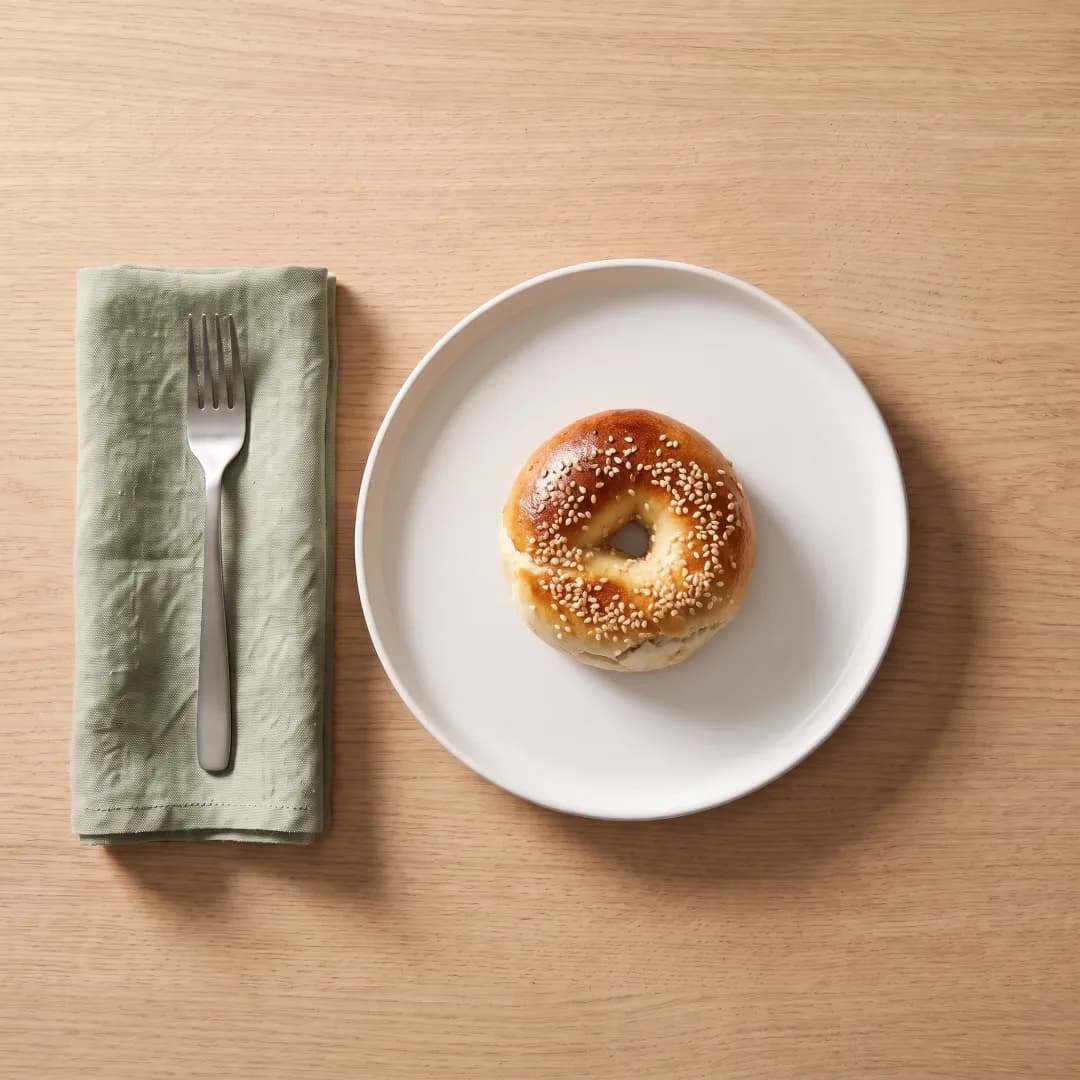
One serving is 1 mini bagel, about 3 inches (makes 8). Prep 20 min · Cook 20 min · Rest or chill 15 min.
Steps
Heat the oven to 375°F (190°C), line a dark sheet pan with parchment and let the oven preheat for 15 minutes.
Whisk the whole-wheat flour, baking powder and salt in a large bowl, add the Greek yogurt and mix into a shaggy dough. Knead on a lightly floured counter about 1 minute, until it is smooth and tacky but no longer sticks to your hands. Cover and let it rest 5 minutes.
Divide into 8 equal pieces, about 45 g each. Roll each into a 6-inch (15 cm) rope about ¾ inch (2 cm) thick and pinch the ends together to make a ring.

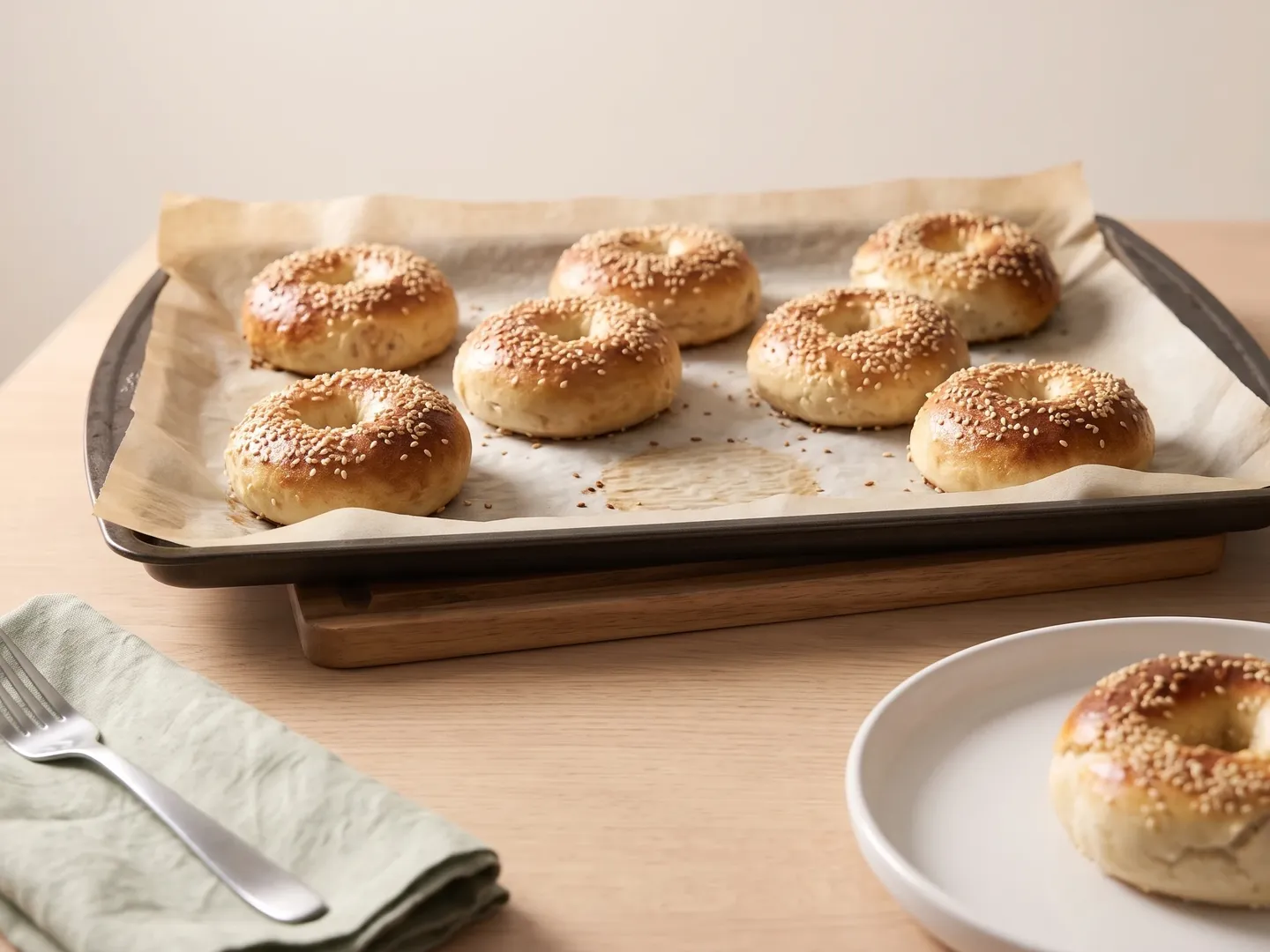
AI-generated illustrative image. Place the bagels on the pan, brush with the beaten egg and sprinkle with the sesame seeds.
Bake on the upper-middle rack until the tops are deep golden and the bottoms are browned but not dark, about 20 minutes; check at 16 minutes on a dark pan. The center of a bagel should read 200°F (93°C).
Let them cool on a wire rack for 15 minutes before slicing.
On the plate
Counts toward the carbohydrate quarter of the plate: one mini bagel adds about 12 g of carbohydrate and 5 g of protein. Add eggs or smoked salmon for a full breakfast.
Nutrition
| Nutrient | Per serving (1/8 of recipe) |
|---|---|
| Calories (kcal) | 78 |
| Total carbohydrate | 12 g |
| Dietary fiber | 2 g |
| Total sugars | <1 g |
| Protein | 5 g |
| Total fat | 1 g |
| Saturated fat | <1 g |
| Sodium | 195 mg |
Total carbohydrate includes fiber, as on US nutrition labels. Values are calculated from USDA FoodData Central for the ingredients as listed and are estimates. How we calculate.
Where these numbers come from
| Ingredient | Weight | Carbs | Source |
|---|---|---|---|
| whole-wheat flour Whole-wheat flour | 120 g | 86.4 g | “Wheat flour, whole-grain (Includes foods for USDA's Food Distribution Program)”, USDA SR Legacy, FDC ID 168893 |
| baking powder Baking powder, double-acting | 8 g | 2.2 g | “Leavening agents, baking powder, double-acting, sodium aluminum sulfate”, USDA SR Legacy, FDC ID 172803 |
| salt Salt | 2 g | 0.0 g | “Salt, table”, USDA SR Legacy, FDC ID 173468 |
| Greek yogurt Greek yogurt, plain, nonfat | 225 g | 8.2 g | “Yogurt, Greek, plain, nonfat (Includes foods for USDA's Food Distribution Program)”, USDA SR Legacy, FDC ID 170894 |
| egg Egg, whole, raw | 25 g | <1 g | “Egg, whole, raw, fresh”, USDA SR Legacy, FDC ID 171287 |
| sesame seeds Sesame seeds | 8 g | 1.9 g | “Seeds, sesame seeds, whole, dried”, USDA SR Legacy, FDC ID 170150 |
Counted as zero because the source has no value and the amount is 1 g or less per serving: baking powder (); salt (); sesame seeds ().
Calculation engine v1.3.0.
Swaps and variations
- Everything topping
- Mix the sesame with ½ tsp each of dried garlic and dried onion flakes.
- Self-rising flour
- Use it in place of the flour, baking powder and salt. It isn’t whole wheat, so the nutrition changes.
Storage
Keep in a bag at room temperature up to 1 day or in the fridge up to 3 days, or slice and freeze up to 3 months; toast straight from the freezer.
How we checked this recipe
We haven't cooked this recipe in our kitchen yet. Before publishing it, we compared it with tested recipes of the same kind and checked how its ingredients behave and its safe temperatures.
- The dough should feel tacky, not sticky. Nonfat Greek yogurt is thick enough; regular yogurt is not. Extra flour kneaded in adds carbohydrate.
- Weigh the pieces (about 45 g) to get 8. If you make 6 bigger bagels, each has about 16 g of carbohydrate.
- Ovens and dark pans vary. Go by the color and a thermometer (200°F in the center) rather than the time alone; underbaked yogurt bagels are gummy inside.
- These are dense and chewy, not boiled bakery bagels. They toast well.
Tested recipes we compared
- Easy Bagel Recipe · Skinnytaste. Flour, baking powder and nonfat Greek yogurt bagels, rated by more than 1,500 readers; a tacky, not sticky, dough at 375°F
- Two-Ingredient Dough Bagels · WW. Self-rising flour (or flour and baking powder) with Greek yogurt; egg wash instead of boiling; a short rest
- Miraculous Homemade Bagel Recipe · Once Upon a Chef. Flour, baking powder and Greek yogurt, baked on the upper-middle rack at 375°F
How the ingredients behave
- How to substitute whole wheat for white flour in baking · King Arthur Baking. Whole wheat absorbs more liquid, and a short rest makes the dough easier to shape
- Doneness Temperatures for Baked Goods · ThermoWorks. Quick breads and biscuits are done at 200 to 205°F
Food safety
- Leftovers and Food Safety · USDA FSIS. Refrigerated storage of 3 to 4 days
Nutrition values are estimates calculated from USDA data for the ingredients as listed. This recipe is information, not medical advice; decisions about your diet belong to you and your healthcare team. How we calculate.
Printed from diabetesbites.com/recipes/greek-yogurt-protein-bagels. Nutrition per serving is calculated from USDA FoodData Central for the ingredients as listed.
FAQs
Quick answers about greek yogurt protein bagels.
How do you make bagels with Greek yogurt?
Mix it with flour and baking powder. The baking powder makes the dough rise in the oven without yeast, and the thick yogurt is the only liquid, so it adds protein too.
How many carbohydrates are in a protein bagel?
About 12 g in each mini bagel, with 5 g of protein. A bakery bagel is several times larger, so it has several times the carbohydrate.
How was this recipe?
Be the first to rate it.